
Railway Oriented Programming
- Published on
What is it?
- One of the patterns for handling errors in programming
- The basic idea is to think of errors as occurring in a program, and to maintain a two-track structure for the entire program.
- That is, thinking of successful cases as success tracks and unsuccessful cases as failure tracks.
- Used in functional programming as a monad, allowing functions to be chained together for better implementation and handling.
Why use it?
- The
try...catchmethod breaks the flow of control, making it difficult to understand the flow of the programme. - Explicitly indicates that an error will occur.
- Can handle both errors and successes, while keeping the flow of the program clear.
How to use it?
- Use the
Eithermonad to handle both success and failure. - Not all functions need to be made to return
Either, but the interface for connecting them should be two-track. Use the appropriate adapters for each connection. - Here we use
Resultfrom thekotlin stdlibinstead of theEithermonad to show a success/failure example.
Adapters
Existing programs may not return a Result, so you need to use the appropriate adapters to make them do so
- Single track functions - for handling successes only
Result.map { singleTrackFunction(it) }
- Dead-end functions - if there is no return
Result.onSuccess { deadEndFunction(it) }
- Functions that throw exceptions - if they throw exceptions
Result.mapCatching { funThrowsException(it) }
- Supervisory functions - for handling both and no conversion, e.g. logging, etc.
Result.onSuccess { println(it) }
      .onFailure { println(it) }
Example
The original author used F# to show the example, but we'll show it in Kotlin.
Functions for applying the adapter
validateUserInput- a function that returns both success and error.canonicalise- a function that only returns successupdateDb- function with no returnsendEmail- a function that throws an exception
Two programmatic implementations
handleUserRequest- a function that handles both success and failure usingResult.handleUserRequestByImperative- an implementation ofhandleUserRequestabove usingtry...catch.
Both methods return the same result, but somehow handleUserRequestByImperative seems more concise. However, the command-line method becomes more complex when additional exceptions are handled in individual functions. It's also harder to tell which errors are explicitly thrown and where the flow stops.
[handleUserRequest function is two-tracked through an adapter].
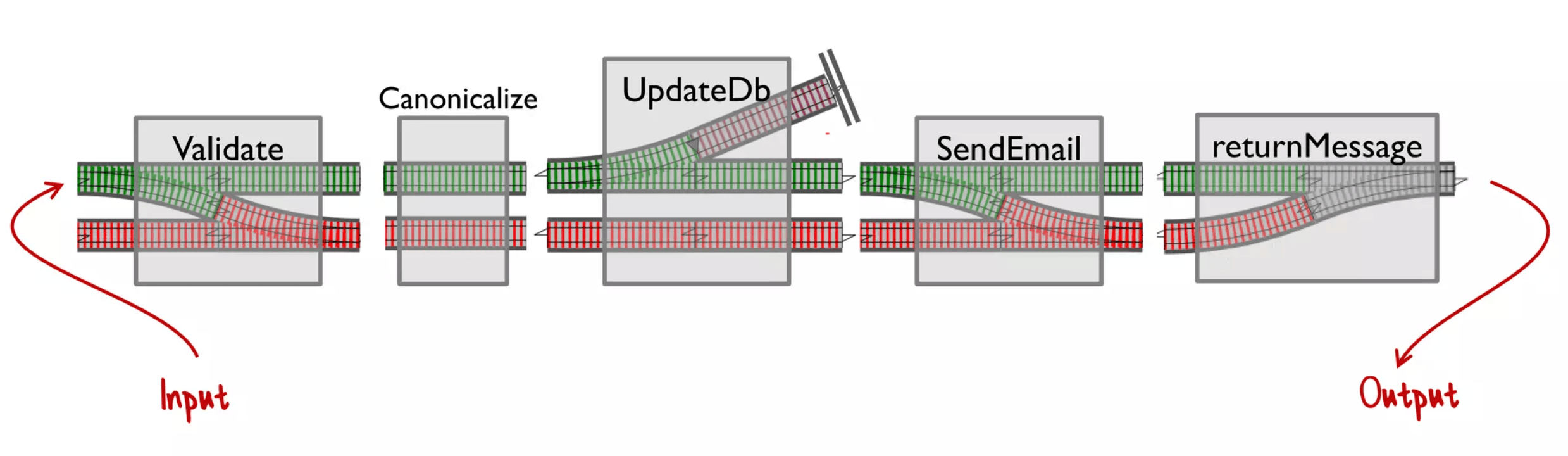
Example code
Put the following code in your main.kt file and run it.
fun validateUserInput(req: Request): Result<Request> {
    if (req.input.isEmpty()) {
        return Result.failure(RuntimeException("input is empty"))
    }
    return Result.success(req)
}

fun canonicalize(req: Request): Request {
    return req.copy(input = req.input.trim())
}

fun updateDb(req: Request) {
    println("updateDb is done")
}

fun sendEmail(req: Request) {
    if (req.input.isEmpty()) {
        throw RuntimeException("Failed to send email")
    }
}

data class Request(val input: String)

infix fun <T, R> Result<T>.flatMap(transformer: (T) -> Result<R>): Result<R> {
    return if (isSuccess) {
        transformer(this.getOrThrow())
    } else {
        this as Result<R>
    }
}

// Implemented in a functional way
fun handleUserRequest(input: Request): String {

    return Result.success(input)
        .flatMap(::validateUserInput)
        .map { canonicalize(it) }
        .onSuccess { updateDb(it) }
        .mapCatching { sendEmail(it) }
        .fold(
            onSuccess = { "OK" },
            onFailure = {
                when (it) {
                    is RuntimeException -> it.message ?: "Failed to handle request"
                    else -> "Unknown error"
                }
            })
}

// Implemented imperatively
fun handleUserRequestByImperative(input: Request): String {

    return try {
        validateUserInput(input).getOrThrow()
        val req = canonicalize(input)
        updateDb(req)
        sendEmail(req)
        "OK"
    } catch (e: Throwable) {
        when(e) {
            is RuntimeException -> e.message ?: "Failed to handle request"
            else -> "Unknown error"
        }
    }
}

// Run the two functions
fun main() {
    val input = Request(" ")
    println("A: " + handleUserRequest(input))
    println("B: " + handleUserRequestByImperative(input))
}